Fulbright Distinguished Award in Teaching Fellowship to Singapore 2016-2017

From Session Participant to Session Leader

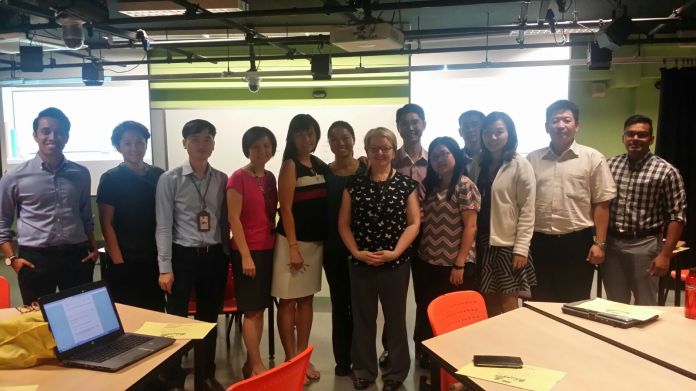
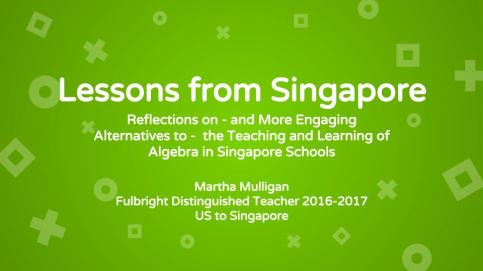
Wednesday was a big day for many of the Fulbrighters – both the US and Singapore teachers. Except for one of the US teachers who left earlier, all of us had our Fulbright Sharing Sessions at AST on Wednesday. Even though I still have several weeks left in my stay here, it felt very much like a culminating activity. My session was titled “Lessons From Singapore: Reflections on – and More Engaging Alternatives to – the Teaching and Learning of Algebra in Singapore Schools.” (I’ll blame my affinity for long titles on my friend Michael.) We each presented twice and the sessions were open for free to all Singapore teachers. For a Wednesday afternoon, after school hours, I was impressed with how many teachers came to the sessions. Almost all of the 30 teachers who pre-registered for my session showed up. I know how hard it is to get downtown after teaching all day (see last post), so I can understand that there were a few no-shows.

Lessons from Singapore - Reflections, Alternatives- Algebra

In my ‘sharing session’ (that’s what most people call them here, not PD), I shared what I have been doing at my attachment schools, some observations and reflections that I have had about my time here observing classes and interviewing teachers. More that half of my sharing session was about Desmos, though. I presented Desmos activities as more engaging ways to present material to students than lecturing or worksheets. Out of the two sessions, there were two teachers who had heard of Desmos (but not the Activity Builder) and used the graphing utility quite a bit. Of course, there were a few teachers from my attachment schools who were there to support me (thanks!) and had heard of Desmos. I felt a little guilty that two teachers came from my second attachment and much of my presentation was the same from when I led a sharing session at their school. Gotta get some mileage out of this material, though. 🙂

I appreciated that I attended the AST Primary 3 and Primary 4 workshop on Tuesday, right before leading my own. I couldn’t help but note the times when the other session leaders asked teachers to do some problems or to present their work. I gave teachers plenty of time for the ‘doing,’ but less time for ‘presenting’ because each session was only 75 minutes. On the feedback forms, many of the teachers said that my session was too short, so I’ll take that as an indication that they wanted to spend more time with Desmos!

Then on Friday I led another sharing session with my third attachment school. I talked with the math HOD (Head of Department) earlier in the week in preparation. I wanted to be clear about what she (and the department) wanted from me for that session. We determined that sharing best practices and ICT integration would be a good learning experience for all. As you can probably guess, I presented Desmos stuff, but I also presented other ways to get students collaborating and talking more to each other. She told me that her teachers ‘learned quite a bit’ in the session and is hopeful that they will try Desmos in their classes. In general, the teachers gave me positive feedback, too.  I admire this HOD’s tenacity in convincing other teachers that teaching students mathematics is more than just telling them about it.

I have at least one more opportunity to present here in Singapore and I’ll be morphing my previous presentations into a new one again. “Desmos.com Changed the Way I Teach Mathematics” is the title of my 90 minute session, which is part of the Redesigning Pedagogy International Conference 2017 at National Institute of Education. I’ll be presenting on May 31, so I still have some time for more learning before I am the leader.


Standard
Fulbright Distinguished Award in Teaching Fellowship to Singapore 2016-2017

“We Gave Classroom Sets to Every Classroom in Singapore”

Seriously. That’s what a Singapore Master Teacher told me before starting a workshop on using manipulatives effectively in Primary 3 and Primary 4. My eyes must have bugged out of my head. Singapore’s MOE has spent millions of dollars in ensuring that *all* teachers in *all* primary grades have the necessary manipulatives to use them in the math classes. The Academy of Singapore Teachers regularly hosts training sessions like the one I attended so that teachers can learn how to use them. MOE does all that it can to remove the barriers that teachers regularly face when it comes to good teaching and learning.

Even with all those barriers removed, the facilitators implied that many teachers and schools are not using the resources: “Get these out of the closets in your classrooms,” “Don’t let anyone throw this stuff away if you don’t know what they are for,” and “Ask your HOD if you don’t see these materials around. They are there.” The theme that teachers are not employing best practices, even if they know about them, is one that I have encountered quite a bit recently. I get it. I get that there are other barriers besides not having the physical resources that keep teachers from changing or enhancing their practice. Many times, one of the bigger barriers is the teacher’s own fear of trying or learning something new. I know that I have felt that way at times. But, for the most part, I’m beyond that. I’m willing to learn anything that might make me a better teacher, even if that means making myself vulnerable, taking a risk, and admitting that I have a lot to learn, which I usually do. Sometimes it’s not fear, but real time constraints that keep teachers from learning and growing. I get that too. When we have a stack of papers 4 inches thick and we have to choose between going to a 3-hour workshop on effective teaching or knocking out those papers so we can rest on the weekend, I know which one I would choose.

While the focus of my project is not primary level mathematics, I was eager to learn more about the famous Singapore Math. I am impressed! The Concrete-Pictorial-Abstract way of learning important mathematical ideas is the way to go. I kind of wish that I had a class of my own to try them out on. I don’t think that my own Primary 3 student would always be a willing participant to my mathematical preaching. I’ll have to see if I can find another audience.

Standard
Fulbright Distinguished Award in Teaching Fellowship to Singapore 2016-2017

More Teaching and Learning

In my haste to write about my experience at the primary school, I forgot to write about teaching at my current Singapore secondary school attachment, CCSS. Last week, I taught a Sec3E class and the topic was Graphs of Reciprocal Functions. Of course, I used Desmos, and I had many ‘teachable moments’ – that’s teacher lingo for seizing an opportunity to teach something that perhaps you didn’t anticipate that you would be teaching. Some of those teachable moments were for students and some of them were for myself.

I created the Desmos activity based on the resources that the teacher had already created, and I included what I thought would be easy review questions for the students to do before diving into the new material. I was wrong about the easy review questions. The first slide was a card sort slide in which students had to match positive and negative cubic and quadratic functions with their associated graphs. This was a challenge for most students. A few students didn’t understand how a negative cubic graph matched the function. We talked for a while about what the inputs and outputs of the function would be and how those would appear on the graph. I *think* I made some breakthroughs with some students.

Because the students didn’t already have their own Desmos accounts, when they logged in, their name wasn’t already pre-loaded into the name field. So, being normal teenagers, some of them created more playful names. I either should have required their names (even though I didn’t know them) or, better yet, required that they use a ‘name’ that denoted where they were sitting (Column 5, Pair 3). We had them work in pairs because it was less of a drain on the wifi and the school had 20 iPads, and 40 mini-iPads. We opted for the bigger screens and lower bandwidth demand. Also, working in pairs on Desmos activities can be quite productive when done well…even though this wasn’t always done well.

I had to ask the regular teacher who some of the students were as I was assessing their answers they were putting into Desmos. For some students, there were misconceptions that I wanted to address. For others, I had to address the silly answers that they were submitting. I walked over to a pair of students who had submitted a ridiculous answer. The boy of the pair was smiling with pride at what he submitted, while the girl was embarrassed. “You’re wasting your time when you could be learning something,” I scolded him. I didn’t stop there. “You’re wasting my time too. Please take this seriously and see what you can learn today.” He basically cowered when I capped that off with one of my teacher looks. He didn’t give me any more problems – or silly answers – for the rest of class. As Chance the Rapper says, “You don’t want no problem, want no problem with me.”

So, I probably could have done fewer (or none) of the kinds of questions where students submit their answers to the class, as opposed to just the teacher. Since this was their first time using Desmos, they valued the fact that they could send secret and silly messages to their friends in the room, instead of valuing the fact that they could peer-assess, which is why I use it in the activities. I should have made the activity shorter, too. My collaborating teacher told me that she liked what I created, that it was quite comprehensive, but it was too much for these students for the first time using Desmos. That was a big take-away for me.

Again, we didn’t finish it, so I had to leave it to the teacher to assign for homework. Since, the students didn’t login, the program would not save where they left off. I corrected a couple typos and sent the new version to the teacher and showed her how to make a copy and edit to make it her own.

Through my teaching here, I’ve learned more about the Singapore schools that what I could have learned through merely observing, which had already been a ton! My history of teaching here (and in the States, of course) gives me a little more street cred for a big sharing session that I have coming up tomorrow. All of the Fulbright teachers – both the Singapore teachers who went to the US and the US teachers here – are leading sharing sessions at AST. I’ll be sharing about what I have learned through my observations, but the bulk of my sharing will be about Desmos. Most teachers here have never used Desmos, so I am doing my best to spread this ICT (Information, Communication, Technology) love. I’ll be sure to share some of my own learning in having students use Desmos here and in the States.

Today I have the privilege of taking a professional development session on “Effective Use of Manipulatives in Primary Mathematics (P3 and P4).” I’m excited to learn even more about the foundational math program that seems to be a key lever in Singapore students’ performance on international assessments. Today is a learning day, tomorrow is more of a teaching day. But really, I can’t tell the difference anymore!


Standard
Fulbright Distinguished Award in Teaching Fellowship to Singapore 2016-2017

Serendipity

Several weeks ago when I was talking with my advisor, he suggested that I visit the math classrooms of a Singapore primary school. We had been talking about Algebra foundations and how Singapore is famous for its “Singapore Math,” which often refers to the use of blocks to represent numbers and fractions. The Singapore Math curriculum progresses from concrete representation (the connect-able blocks), to pictorial representation (rectangular pictures of the blocks), to abstract representation (number, fractions, variables, etc.). This is often called Concrete-Pictorial-Abstract or CPA. Not only do student progress through these modes of representations, but they use them concurrently while do math operations. This way of learning math is used around the world – not just in Singapore. And, it provides and excellent foundation to learning higher level math, like Algebra. I was interested in seeing how this plays out in the classroom, from Primary 1 to Primary 6.

On the same day that my advisory suggested this, the professor from my class offered to connect me to a local primary school. Her cousin is the principal of the school, so she felt comfortable reaching out to her on my behalf. It took a few weeks to arrange a date, but I was able to visit yesterday.

PWPPS5

A sign in the main office to cue students how to speak to the staff there.

I saw a Primary 6 class which was working on “revision” – our way of saying review. They had finished the curriculum for the first semester, so the teacher was going over practice problems that were similar to what students would see on their semester exam, which they will have in a few weeks. These were some hard problems. I don’t know the standard math curriculum for US 6th graders, but this seemed beyond what I would assume our students are doing.

Later in the day, I saw a Primary 2 class and a Primary 1 class. I was so impressed with the level of instruction in both of the classes. And, the students were so adorable! I don’t get to see adorable kids in secondary schools (no offense to my students out there; I don’t love you any less…you’re just not *cute* anymore). The veteran teacher in the Primary 2 class not only had excellent classroom management, she had her students using the blocks to represent numbers, combining blocks to represent “more than” and then combining again to represent “altogether.” Then, the students created word problems of their own that either used the same operations or didn’t. I was impressed with the creativity of the students. They also moved smoothly from whole class discussion on the floor and the front of the room to back to their seat where they work in pairs. Everything about the class was deliberate and educational.

The Primary 1 class was just as impressive with a new-ish teacher in charge. They were using the connect-able cubes to add one digits problems like 8 + 7 and 9 + 3. First, they would make a “number train,” then they would keep the larger number intact and break up the smaller one to make 10 in the larger one. Then they would add 10 + 5 and 10 + 2.  This understanding of base 10 is crucial for more learning later. “Making 10” with the blocks translates to “add and carry” in the abstract representation of addition.

I don’t have any pictures of the Primary 1 and Primary 2 classes, but I do have a story that conveys the cuteness of the Primary 1 class. I walked over to interact with one group of six students as one student connected the blocks together.  “I think you are very pretty,” one girl said. “I think you are very pretty, too,” I said to her. “I just dropped my first tooth,” she said. “Congratulations,” I said. “Now, you are a big girl and not a little girl anymore.” She nodded sheepishly. “I’ve dropped six teeth!” “I’ve dropped 10 teeth!” Then, all six of them gave me a report on their dental changes. (“Dropping a tooth” instead of “losing a tooth” is added to the long mental list of phrases that are different here than in the US.) “Are you from the United States?” a boy asked. “Yes. Can you tell by the way I talk that I am from the US?” They all nodded. Our exchang quickly transitioned back their math problem and making the number train. They were happy to get back to work.

Another serendipitous event happened as a result of this visit too. I had a lengthy discussion with the Primary 6 teacher after he taught class. I shared with him some Desmos love and he shared other educational technology tools. I bookmarked a ton of them to see which ones I want to come back to. It was a productive, yet unplanned, sharing that seemed mutually beneficial.

Choon Shing, the teacher who coordinated my visit, was *another* example of a generous and gracious host. He created a schedule for me, gave me a useful research article on the history of the Singapore Math approach, and allowed me to peruse the resources of the school. I continue to be impressed by all the educators here. They are willing to share their practice with me – even if it’s only for a day. This whole Fulbright experience can’t be described as serendipitous, but I do consider my lucky to experience it all.

Standard
Fulbright Distinguished Award in Teaching Fellowship to Singapore 2016-2017

I Miss Collaborating

In my first year at Northside, a colleague told me that teaching is very isolating. Yes, we spend our day with people – adolescents – but it’s not the same as spending it with adults. I love teenagers, too. I generally don’t complain about spending time with them. But I don’t work with them in the same way that I work with adults. Most teachers I know work so hard in a typical day that they don’t have time to have regular, adult conversations with other teachers. We sit in our classrooms to grade and plan when the students aren’t there. We eat lunch in 10 minutes while reading and sending emails. We don’t even need to go to an office to use a phone anymore because it’s easier and quicker to use our cell phones when we call parents. I knew what that teacher was talking about immediately – teaching can be a lonesome profession, even when you are surrounded by (smaller/younger) people all day. It takes a concerted effort to collaborate with other teachers.

I have made that concerted effort to collaborate with other teachers and the teachers at Northside make it easy to do so. We readily share resources, offer and accept advice without ego, and generally work very well together, even given the little time that we have to do so. On a good day, we can plan an entire lesson in the eight minute passing period. OK…that might be a stretch, but sometimes our most productive collaborations (have to) happen on the fly. One year, the stars were aligned: My friend/colleague Jill and I were teaching the exact same classes and had a prep period and lunch period at the same time. It was glorious. We co-created lesson plans and assessments; we revamped activities to integrate technology; we talked about how to grade assessments and create rubrics; we talked about students and how to best engage them. We hit our groove and kept it for the year. Alas, it was one year only.

I met with a new colleague, Amy, at CCSS today to talk about a lesson that I am going to teach tomorrow (btw, yay!). I had observed her class yesterday and today for about 30 minutes each. She is teaching a unit on graphs of functions and graphical solutions. She asked me whether I wanted to use Desmos in a lesson and, of course, I jumped at the chance. In yesterday and today’s lessons, she taught students the general characteristics of cubic functions and how one could use a graph to solve equations involving cubics. I’m doing the same thing tomorrow, but with reciprocal functions. The sections in the textbook after that are for exponential functions and then gradients of a curve. (On a side note…I can say that I don’t really understand how the learning units are organized in the math textbooks. It seems like the books jump from topic to topic. I should save this observation for another blog post, though, when I have time to really process it.)

So, Amy and I talked for a while about a range of topics, including technology integration and barriers to that integration.  We talked about how to get students engaged and how to help them to better retain what they learn. We talked about O-level test questions. We talked about the flow of the lesson. We were collaborating! Yes! I worked for most of the rest of the day on a Desmos Activity Builder that was modeled off of resources that she and her department already developed. I don’t know that I would have approached the material in the same way if I didn’t use the Sec3E1 Maths Resource Book, but I wanted to honor the work that she already put into the topic. I also wanted to challenge myself to use it *and* make it as thought-provoking and constructivist-aligned as I could.

My conversation with Amy continued over lunch after class. She took Alex and me out to nearby HDB mall with a small, air conditioned food court. It was nice to get off campus for a little while. At the other schools I was attached to, there were coffee shops, hawker centers and large malls nearby. However, CCSS is surrounded by HDB’s and there’s major construction of a new MRT station right in front of the school; it makes it hard to get off campus for lunch. I like the food at the school’s canteen as there is always a Chicken Rice option, but getting out of the building for a few minutes is always welcome. Amy drove us over while we talked shop the whole time.  We talked more about differentiated instruction, about assessments, about cultural differences in the approaches to teaching, and about PLCs. We probably could have talked for another hour or so, but Amy’s lessons and my work pulled us apart.

As I continue to work here on my project, I’m realizing more and more how much I miss collaborating with like-minded colleagues. When I hit my stride, I can be productive – aligning standards and assessments, planning activities, generating thoughtful questions, creating Desmos activities and Google forms and slides. But, it’s still not the same as working on all of this with colleagues who are just as invested in the outcome as I am. Of course I knew it going into this project that I would be on my own in completing it. I’m getting tons of support from the good folks at AST/MOE, from my adviser at NIE, and from the teachers and administrators at all of my attachment schools. I’ll be sharing some of my work next week at an AST-sponsored Fulbright Sharing Session. Still, it’s just not the same as digging in with my peeps and seeing what we can produce together.

dinner_Liz_LayKheng

Dinner with Liz and LayKheng. It was my first time eating Fish Head Curry and it was delicious!

On a related note, I’ve also been missing having girlfriends around to talk to easily.  My conversations with friends about work, parenting, politics, etc. are kind of a collaboration on life. I was craving a ladies’ night out over the weekend and luckily two of my new friends were available. Liz, a Fulbrighter from NYC, and LayKheng, a Singaporean Fulbrighter, met me for dinner, shopping and dessert on Saturday night. I’ve had plenty of that combination with my two *ahem* younger ‘girlfriends,’ Hazel and Lulu, but Liz and LayKheng didn’t incessantly ask me to buy them everything as we walked through Bugis Junction and Bugis Street. The three of us could talk freely about our Fulbright stuff, about food and travels, and about life in general.

Of course, my main collaborator on life (and education and teaching and parenting and paying bills and everything else) is always helpful. Johan and I have certainly proven that we have a strong marriage as we have learned to lean on each other more in the past few months, bringing this idea of collaboration to a whole new level. I’m grateful to have such a great collaborator in that regard.

Standard
Fulbright Distinguished Award in Teaching Fellowship to Singapore 2016-2017

Commute Observations 

Now on my third school attachment, I have various observations about the different lengths of the commutes and the regions around the schools themselves.

This commute is definitely the farthest for me. It took 1.5 hours this morning via bus-train-bus to get to Woodlands. One of my NCP colleagues reminded me that some of our students have one-way commutes like that and that now I know what they experience. That’s partially true. I can relate to the time aspect of traveling across a city on public transit to get to a school, but I can’t relate to the other barriers that some of them face as a result of living in neglected parts of Chicago and going to school in a generally safer, not-neglected neighborhood. In fact, I have not encountered an unsafe part of Singapore, though I’ve been told to avoid the Geylang neighborhood at night…not that I was thinking about it. My navigation here does not compare to theirs in Chicago.

My commute to my first attachment at KRSS was only 45 minutes and to TSS only 60 minutes. I laugh that I write “only” in front of those numbers when I would have found those to be utterly unacceptable for me back home. My and my family’s quality of life is significantly and positively impacted by keeping most of our lives’ activities with a 1.5-mile radius of our home. I realize that we are fortunate in that regard.

Another observation I’ve made while getting off the train at Woodlands and heading to my bus is that I’m the only white person moving through the crowds of people. At the Tampines stop, I was one of a few. And at the Clementi stop, there were a few more. Most of the white/European population is closer to the city center. We didn’t know that when we picked our apartment. I was told to find something central and I assumed that it was for ease in commute to all the school locations.  
The northern part of the city is much less developed than the southern part. I imagine that it’s for historical reasons and that the seaports were the main economic drivers for many decades. Those ports are still mostly south and central, hence the population and development concentration there. The first time I rode the redline all the way around its loop, I was shocked at how many trees there were and how many fewer high rises there were, compared to most regions around the green line, which is the oldest line in the city and runs East-West through downtown and stays mostly south. 

In a previous post, I’ve commented on being in an ethnic minority group for the first time in my life. As the only white person, or one of a few,  for miles around, I know that my experience of being in the minority does not compare to those who do that regularly in the US. If anyone ever believed that white privilege doesn’t exist, I can assure them that it does – even when whiteness is not the majority. I know that it’s far easier for me in my light skin to be among darker-skinned folks than it is for one dark-skinned person to be among all whites. I wish that weren’t true, but it is.

Back to life on the bus/train…I’m doing my best to embrace this life of spending nearly 20% of my waking hours on a train or bus. I read when I can find a seat. I catch up on emails that arrive from US folks when I’m sleeping. I do most of my facebooking and tweeting then, too. While sitting on the 901 and 963 to AST now, I’ve written this entire blog post. I can’t say that I’m productive all the time, but I’m keeping my eyes and mind open while I move about this spectacular city. 

Standard
Fulbright Distinguished Award in Teaching Fellowship to Singapore 2016-2017

Back Up from Down Under

As part of the Fulbright DAT program, we teachers are encouraged to attend professional development while on the program. The Fulbright program even allocates funds for us to do so. It’s like the exact opposite of what educators are accustomed to: an unfunded mandate. It’s a…funded suggestion.  When I went searching for a conference to attend for my professional development, I started by asking my faculty adviser and by looking at what was happening with education in Singapore.

It felt a little strange for me to seek out my own professional development. I can’t say that I am always encouraged to do so. In the busy-ness and business of teaching, I can’t always find the time to seek out new conferences and new places to learn. I am aware of many conferences in the US and Chicago area as they come up because I am a member of different professional organizations. I usually hear of these conferences by way of email blasts, so I never have to discover them on my own. And, I attend them when I can. I also keep abreast of some goings-on by following other educators on Twitter. Twitter is great for digital connections and inspirations. As with any other social media platform, connecting online is not the same as connecting in person. Conferences are best for this. Again, as most teachers know, it’s hard to carve out time to attend them, even when we know how much they will inspire us and how much they can improve our practice. Everything else in teaching seems so immediate, so imminent, that’s it’s difficult to take time out to both find what else is out there and to attend those conferences/professional development/classes that are out there. Teachers know that we get caught up in planning for classes; grading classwork, homework, tests, quizzes, portfolios, projects, and other assessments; collaborating with teachers and administrators; communicating with parents; the school year is over in a blink of an eye. I am fortunate and grateful that I was given this opportunity to find some new PD and the time to take advantage of it. Being in a new country forced me to look in new places. I couldn’t rely on my old standbys.

In late January, I found out about a conference in Singapore that not only did I want to attend, but I applied to present at it. “Redesigning Pedagogy International Conference” will be hosted by National Institute of Education Singapore in late May/early June. Luckily, I happened upon this conference when there was still time for me to apply to present. When I consider what has *redesigned* my own teaching practice, I think about how changes in technology have positively impacted my teaching. In recent years, the online graphing app Desmos has done that to a great extent. In previous posts I have written about how I shared Desmos with the math teachers at my school attachments. So, I decided to submit a proposal, “Desmos.com Changed the Way I Teach Mathematics” and it was accepted. I get to present at an international conference before I leave! I am pretty excited. And, since I am a presenter, my conference fee was very low. I decided to pay for it myself and to request funds from Fulbright to attend another conference.

Related to how Desmos has affected teaching, I was interested in attending a conference on how to better integrate technology into my teaching. My school has been using the Google Apps for Education, aka G Suite, including Google Classroom, for a few years. And many teachers have been slowly adding different apps to their teaching each year. For my Fulbright Inquiry Project I am working to develop a summer Algebra curriculum and I seek to effectively integrate technology into that specific curriculum. I want this curriculum to employ some google apps and other technology tools. I wanted to learn more of them, and I wanted to learn more about the ones that I do employ. An integral part of engaging US students with mathematics content is the effective integration of technology.

Perhaps predictably, I did a Google search and discovered a conference in Australia – The EdTechTeam Melbourne West Summit: Featuring Google for Education. At first I wasn’t certain that travelling to Australia would be feasible and I was hesitant to take time away from my school visits. Then I realized that was the kind of mentality that usually kept me from attending professional development while I was teaching, so I didn’t want it to hold me back while I have this precious time away from teaching. I sent my application for the professional development funds to IIE and soon learned that it would be supported. I then paid my registration fees, booked my flights, booked my Airbnb, and planned my trip.

In order for me to attend my first day at CCSS on Monday, April 3, I booked a redeye flight that would get me to Melbourne on the morning of the conference. This wasn’t ideal and not part of my original plan – I wanted to be in Melbourne the evening before the conference – but I didn’t want to miss the introductions and welcome at CCSS. Of course, on the flip side, I felt bad that I was only meeting everyone for a day before I had to jet out (literally) again. I’ll be diving back into things at Christ Church tomorrow.

I was able to sleep a few hours on the plane before landing in Melbourne so I wasn’t a complete mess when arriving at Manor Lakes College, which is a K – 12 public school in a suburb of Melbourne. Most of the educators at the conference were local teachers, and many from that particular school. I soon learned that local teachers were attending this conference while on their Easter Break, for which they get two weeks off. It was a small conference and I particularly appreciated that I wasn’t one of hundreds of participants.

I attended several breakout sessions in the conference – all of them conducted by Google Certified Educators and Trainers. It was great to learn from educators who have done some of the ‘figuring out’ for me. That is, they have vetted the apps that they were talking about and knew how to work through some of the kinks. That’s the advantage of going to a conference, versus taking time to hack through some of the apps yourself. I attended sessions on dealing with data, Google apps from A – Z, Google Expedition and YouTube. All of these sessions were inspiring – I haven’t really finished processing all that I learned and how I will use what I learned. I also bought two books at the conference – “Dive Into Inquiry” and “Code in Every Class.” These books, too, are providing me with a lot of food for thought.

After the conference, my family and I explored Melbourne and the surrounding area. Melbourne was lovely. One of my favourite (not ‘favorite’) parts of the city were these ‘laneways’ downtown. Essentially laneways are like alleys in downtown Chicago, except they are not at all creepy or scary or dark or dingy or dangerous. They are only for pedestrians, have cute shops and restaurants lining them, and they lead you through to other streets and arcades and malls. We ate a few meals in these laneways and enjoying walking about the city. Perhaps these are the urban versions of the Australian walkabout.


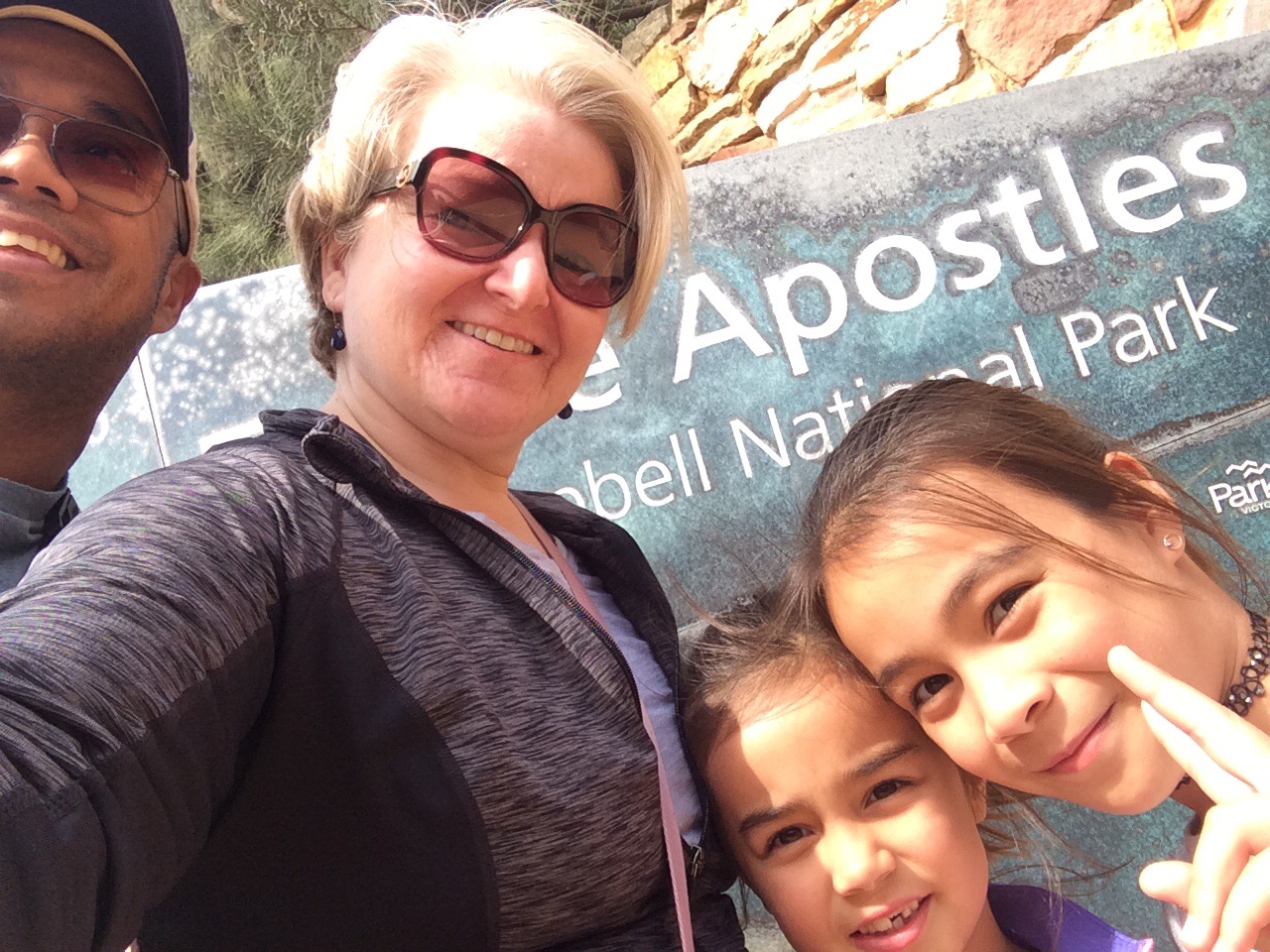
We also got out of the city by renting a car and driving – ON THE LEFT SIDE OF THE ROAD! – to the Twelve Apostles. Visits to Eureka Skydeck ScienceWorks and the Melbourne Zoo made us really feel like legit tourists – so did all of my communications mistakes: Is that really lemonade? What’s a jaffle? …thinking it was *spring* break when its autumn there…lemonade=sprite, an so on…probably more than I can recall right now.

We had a good time, but I missed Singapore. I missed the friendly people and the Singaporean accents, which are different than the Australian accents. I also missed Chicken Rice, but we took care of that as soon as we got back and off the bus home. I didn’t miss the heat and humidity, but I’m still happy to be back.

Standard
Fulbright Distinguished Award in Teaching Fellowship to Singapore 2016-2017

From “Up North” to “Down Under”

Yesterday I started a new school attachment at Christ Church Secondary School, which is located in the Woodlands neighborhood in Chicago. I have to commute via bus-train-bus to get there, which takes up to 1.5 hours total from door-to-door. This is definitely my longest travel time out of all my attachments. When I first rode through the Woodlands area on the MRT a few weeks ago, I was surprised at how undeveloped the area is. There are much fewer HDBs – the government supported housing high-rises that line the path of the East-West Line. I had become accustomed to those on my previous commutes and it was shocking to me that the area in the norther part of the island is not as developed. Just when I thought I had some aspect Singapore figured out (like thinking it’s densely populated everywhere), I learn something new. That’s pretty much the theme of my entire experience anyway – I keep learning new things.

CCSS is another welcoming school with committed teachers and visionary leaders. They, like the other two schools I’ve been attached to, really know how to roll out the welcome mat for us Fulbrighters (another Fulbrighter is assigned to the school with me, whereas I was on my own at TSS). An introductions of the school’s mission and vision was followed by a tour of the campus. It’s another huge campus with multiple blocks/buildings of at least 3 floors high. The school has labs, outdoor high ropes and climbing walls, a dance studio, art studio, refurbished library, an after-school drop-in center, a ‘gardens by the fence,” and even a zip-line. All around the school’s stairwells are educational messages that are related to the mission and current directives of the schools. These intentional messages about learning not only promote and reinforce messages from the teachers, they also send the message that the school is serious about what they are talking about. Everyone walks the walk and talks the talk. I’m looking forward to seeing how this plays out in the math classrooms.

While I anticipate my classroom observations at CCSS, I have to wait until I return to Singapore. I took a red-eye last night to make it to Melbourne, Australia this morning. I’m attending a conference on google apps for education. I may even be able to share what I learn with teachers at CCSS when I return.

It didn’t take long for me to forget that I was in the southern hemisphere. “Are you on Spring Break right now? They looked at me kind of funny. Teachers here are on “Easter Break” for the next two weeks. “Oh, wow. Do you get another Spring Break, too?” Yes, they get one in September, which makes a ton of sense because that’s when they have spring ‘down under.’ Oops. I won’t make that mistake again.

Standard
Fulbright Distinguished Award in Teaching Fellowship to Singapore 2016-2017

From TSS to CCSS

I had my last day at TSS on Friday. It’s hard to believe that five weeks have passed since I started there. They flew by – even more than my five weeks at KRSS. I think I hit my stride somewhere in these past several weeks – both in my professional work and in my routines and personal/family life.

On Thursday at TSS, I facilitated a professional development session with most of the math department, some other teachers and one vice principal. As part of the Fulbright program, we were encouraged to proposed various PD we could offer to teachers at our school attachments. Of course, I offered workshops on using Desmos, which we did last week. I also offered a kind of book club on the book “Mathematical Mindsets” by Jo Boaler. My fabulous colleagues in the math department at Northside are reading the book a few chapters at a time and then discussing those chapters as part of PLC’s we have regularly. I thought we could do a similar thing with Singaporean schools.

As it turns out, TSS faculty were reading Carol Dweck’s “Mindset” book, so Thomas, the Math Head of Department, thought that a discussion on some part of Boaler’s book would be appropriate. We didn’t have a book club like NCP and the teachers did not have the book ahead of time to read. Thomas suggested that I focus on the ideas in Chapter 9 of the book and I presented those in the most interactive way that I could. I even slipped in some Desmos into this session…no surprise there.

2017-03-30-PHOTO-00000033.jpg

On my last afternoon I was interviewed by TSS students. They asked about my experiences at TSS and asked about the differences between their school and Northside.  We also discussed more generally schools and students in Singapore versus Chicago. It was a great discussion and I was very impressed with the poise of the students. I’m not quite sure where that video is going to end up, but I’m pretty sure it will be trending on youtube in no time.

I’m pictured with an original art work that was done by an alum of TSS. I was so touched. Also, Thomas hooked me up with complete sets of the math games that his teachers have developed. I’m pretty stoked about my TSS swag!

I start my new school attachment at CCSS tomorrow morning. It’s a new commute, on a new train line, in a different direction in the city. Just like last time, I’m sad that I have to move on when it felt like I was hitting my groove. But, I’m also looking forward to meeting more outstanding educators and learning even more from them.


Standard
Fulbright Distinguished Award in Teaching Fellowship to Singapore 2016-2017

Why Can’t We Have Nice Things?

There are memes out there that say, “This is why we can’t have nice things…” I won’t bother posting one because they are pretty ubiquitous anyway. Either the picture in the meme depicts the reason why we can’t have nice things (like a cat tearing up a sofa) or depicts a person disappointed that we can’t have nice things (like President Obama frowning in despair). Someone could have taken a picture of my face as I walked around at the MOE ExCEL Fest 2017 this past Thursday. I kept thinking, “Why can’t Chicago Public Schools do anything like this?” I didn’t come up with a definite answer, so I can’t create a meme for why we can’t have nice things like the MOE ExCEL Fest.

The MOE ExCEL Fest is a “platform to celebrate and share exciting and innovative practices in schools.” I was so impressed as I walked around the huge Suntec Singapore convention center. Students and teachers were showcasing the work they do in their schools. TSS had a booth that showed their nascent work in the Applied Learning Program, which they recently began as a co-curricular activity. Students presented their work and visitors could interact with them about their projects. I got there toward the tail-end of the exhibition times, so I only got to say hi to the TSS students as they were wrapping up their exciting day. I did manage to snap some pictures of some of the exhibits.

So, I guess I took more than a few pictures. CPS does science fairs (what district doesn’t?). We also have school fairs, but those are more about feeding into the competition between schools and allowing schools to “market” themselves in one location. We don’t have a venue where schools are encouraged to show off the innovative practices they have. I can’t even say that schools are encouraged to BE innovative, now that I think about it. Of course, many schools are doing innovative work, but there’s not central place where it can be showcased and celebrated. What a shame.

My gut tells me that the reason that we can’t have nice things like this is because of funding. Singapore spends money on schools in a way that the US schools cannot compete. Education is a top priority. Singapore spent over 12 billion dollars (SGD) on education in 2015 (which is about equivalent to 8.5 billion in USD). Chicago’s budget is under six billion for this school year and there’s a good chance that the school year will end early because it doesn’t have enough funds to cover the entire year.  Chicago’s district serves under 400,000 students and Singapore schools enrollment is about 450,000 students. Those numbers just don’t compare. I think I know why we can’t have nice things. Sigh…


Standard